
Frailty Solutions: Scaling a Proven Blueprint for Acute Care
Strengthening Life. Enhancing Independence.
Automating a clinical model validated to achieve 88% same-day discharge and £6M in annual cost avoidance. We are transforming manual clinical excellence into a scalable, AI-powered digital system for the NHS front door.
A clinical syndrome — not simply old age
Frailty is a state of increased vulnerability resulting from age-related decline in reserve and function across multiple physiological systems.
Frailty changes everything about how patients should be assessed
A frail 80-year-old presenting with a urinary tract infection is not the same clinical problem as a fit 80-year-old. Standard pathways miss polypharmacy, cognition, falls risk, social context and goals of care — all of which determine outcome.
- Frail patients have longer hospital stays and higher readmission rates
- Hospital-associated deconditioning can be irreversible after 7 days of bed-rest
- Polypharmacy reviews can prevent up to 30% of admissions
- Early CGA reduces functional decline and improves 12-month survival
“Frailty is not simply ageing — it is a measurable clinical syndrome associated with vulnerability, deconditioning and poorer outcomes.”
The Frailty Crisis
Frailty is one of the most under-recognised, under-funded and under-prioritised challenges facing the NHS today.
The Evidence — A Coherent Approach Can Convert 88.1%
A 24-month prospective NHS service evaluation — frontline, multidisciplinary, front-door geriatric care.
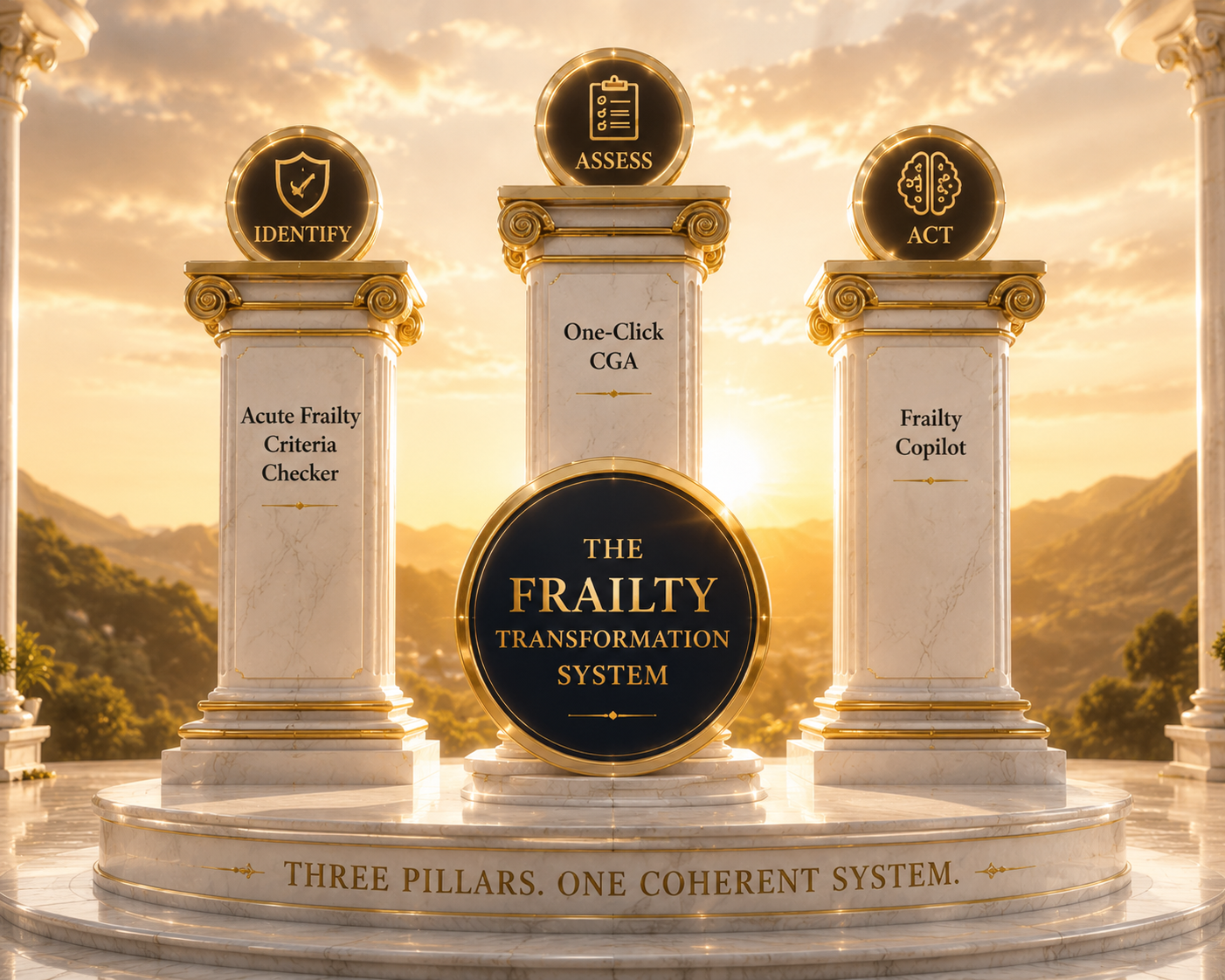
Acute Frailty Criteria Checker
Rapid front-door identification of patients meeting acute frailty criteria — reducing missed cases and ensuring consistent triage.
One-Click CGA
A unified frailty profile covering medical, functional, cognitive, medication and social domains — generated at the point of contact.
Frailty Copilot
AI-enabled decision support synthesising patient data, stratifying risk, supporting safe discharge and structured deprescribing — designed to augment senior clinical judgement.
Register InterestExperience One-Click CGA
Upload a patient note and watch a full Comprehensive Geriatric Assessment generate in seconds.
Frailty Copilot — See the Story, Plan Better Care
From clinician input to a safe, actionable plan — with a human always in the loop.
Ways of Input
Management Plan
- Deprescribing Support
- Diagnosis Coding Guidance
- Discharge / Admit Recommendations
Intelligent Frailty Care, Built for the NHS
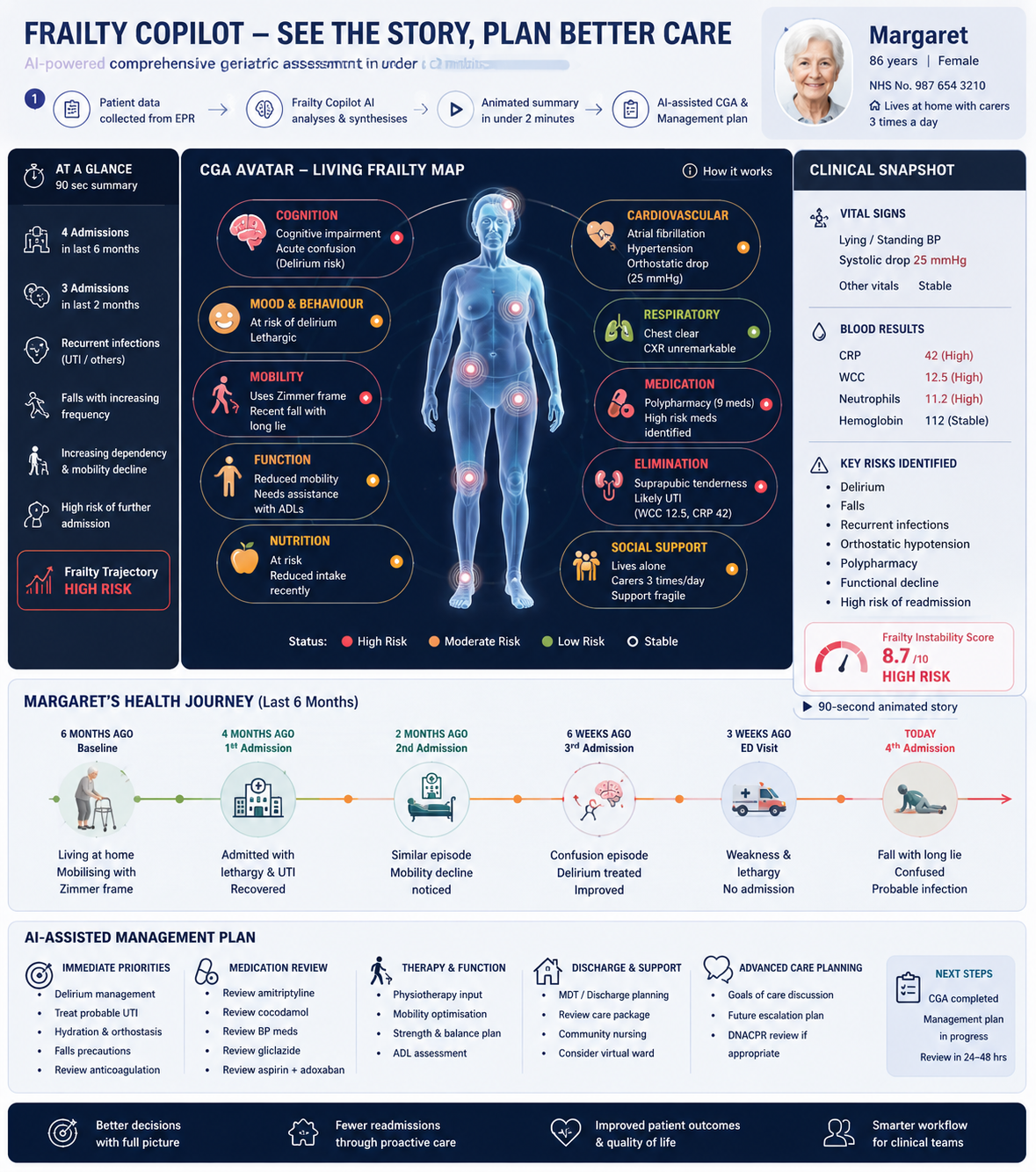
Fictional patient case for demonstration purposes only. Frailty Copilot is in development — not yet available for clinical use.
Front-door frailty care is now NHS policy
NHS FRAIL Strategy
National framework setting standards for acute frailty care across all NHS Trusts.
GIRFT Geriatric Medicine
Getting It Right First Time recommends front-door CGA in every acute hospital.
CQUIN Indicator
NHS England commissioning incentive linked to early identification of frailty.
BGS Position Statement
British Geriatrics Society endorses 7-day acute frailty services as standard of care.
Built at the Front Door. Proven in Practice.
Frailty Solutions was created by clinicians who saw firsthand how the NHS frailty pathway was failing patients at the point of greatest risk — the acute front door.
Founded by Dr Maher Kherbek, Consultant Physician in Acute Frailty Medicine, the initiative is built on one of the largest prospectively documented acute frailty datasets in NHS practice — 3,200+ patients reviewed across 24 months, with an 88.1% same-day discharge rate and measurable cost avoidance at scale.
Dr Kherbek is an NHS Clinical Entrepreneur, Member of the Academy of Medical Educators, and holds postgraduate qualifications in Critical Care and Medical Education. His work spans frontline clinical delivery, service design, clinician training, and AI-assisted workflow development.
Frailty Solutions translates that frontline evidence into practical tools for NHS teams: front-door CGA, structured deprescribing, clinical coding optimisation, and AI-assisted decision support — designed for real ward environments, not academic prototypes.
Aligned with BGS, GIRFT, and NHS England frailty standards.
From Clinical Excellence to Digital Scale
Frailty Solutions was born from a manually validated clinical model that redefined acute frailty pathways. We are now in the final stages of automating this 'gold-standard' workflow through the Frailty Copilot AI. We are seeking strategic partners, health-tech experts, and investors to help us complete this transition and scale this proven impact across the healthcare system.
“Our mission is to take a proven clinical success and make it accessible to every hospital through intelligent automation.”
Have a question or want to collaborate?
Reach out — we'd be glad to hear from clinicians, commissioners, researchers and patients.
Contact us